


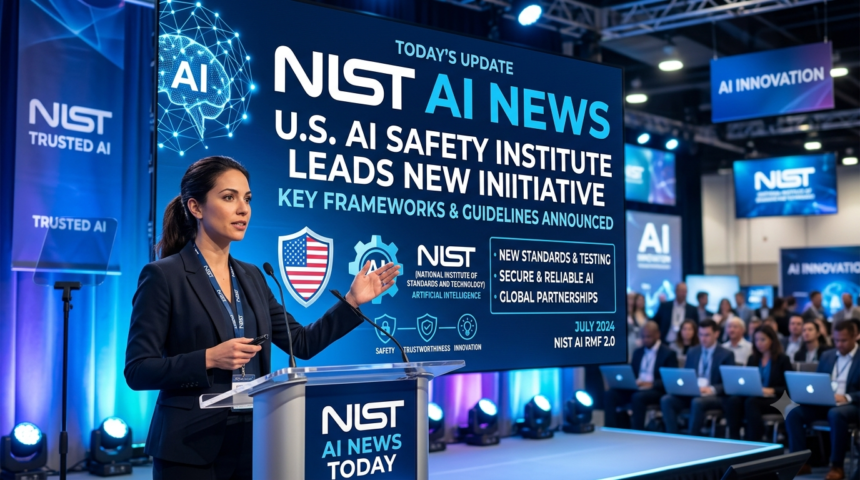
Artificial intelligence continues to evolve rapidly, and NIST AI News Today has become one of the most trusted sources for understanding new AI standards, security practices, and governance recommendations in the United States. The National Institute of Standards and Technology (NIST) plays a key role in helping organizations build AI systems that are reliable, transparent, secure, and trustworthy.
In 2026, NIST continues expanding its AI guidance through updated frameworks, practical tools, and collaboration with government agencies, technology companies, researchers, and developers. Whether you’re an AI developer, business owner, cybersecurity professional, or simply interested in responsible AI, following NIST’s latest announcements is essential.
Fast Info Table
| Topic | Details |
|---|---|
| Focus Keyword | NIST AI News Today |
| Organization | National Institute of Standards and Technology (NIST) |
| Country | United States |
| Main Focus | AI Governance, Risk Management, Standards |
| Popular Framework | AI Risk Management Framework (AI RMF) |
| Audience | Businesses, Developers, Researchers, Government Agencies |
| Updated | 2026 |
| Primary Goal | Safe, Secure, Trustworthy AI |
What Is NIST and Why Does It Matter for AI?
The National Institute of Standards and Technology (NIST) is a U.S. government agency that develops standards, guidelines, and best practices across many industries. While NIST does not regulate companies directly, its recommendations are widely adopted by governments, technology firms, healthcare organizations, financial institutions, and cybersecurity professionals.
As artificial intelligence becomes part of daily life, organizations need clear guidance on creating AI systems that minimize risks while maximizing innovation. This is where NIST AI News Today becomes valuable because it highlights the newest recommendations that shape AI development worldwide.
NIST focuses on several important principles:
- Trustworthy AI
- AI security
- Privacy protection
- Transparency
- Fairness
- Accountability
- Human oversight
- Risk management
Rather than slowing innovation, these standards help organizations develop AI responsibly while reducing legal, ethical, and cybersecurity concerns.
Many global technology companies voluntarily align their internal AI policies with NIST recommendations because the framework is practical and internationally respected.
Latest NIST AI News in 2026
Throughout 2026, NIST AI News Today continues releasing updates designed to improve AI governance and support safer deployment of advanced AI systems.
Several important developments have attracted attention.
Continued Expansion of AI Risk Guidance
NIST continues publishing implementation resources that help organizations apply the AI Risk Management Framework more effectively.
These include:
- Practical implementation guides
- Risk measurement tools
- AI governance examples
- Technical documentation
- Industry-specific recommendations
These resources make it easier for businesses of different sizes to adopt AI best practices.
Increased Focus on Generative AI
Generative AI remains one of the fastest-growing technologies.
Recent NIST discussions place greater emphasis on:
- AI-generated misinformation
- Deepfake detection
- Model transparency
- Prompt security
- Data quality
- AI content authenticity
As generative AI tools become more common, organizations need better methods for evaluating model reliability.
AI Cybersecurity Improvements
Another major topic in NIST AI News Today involves cybersecurity.
Modern AI systems face risks such as:
- Prompt injection attacks
- Model theft
- Data poisoning
- Adversarial machine learning
- Sensitive data exposure
NIST encourages developers to include security throughout the entire AI lifecycle instead of treating it as a final step.
Government Collaboration
NIST continues working alongside federal agencies, academic researchers, and private technology companies to improve AI standards. NIST AI News Today
These collaborations help ensure that guidance remains practical while adapting to rapidly changing AI technologies.
International Cooperation
Although NIST is a U.S. organization, its AI work influences international discussions.
Many countries reference NIST frameworks when developing their own AI governance policies because they offer flexible, technology-neutral recommendations.
NIST AI Risk Management Framework Explained
One of the biggest reasons people search for NIST AI News Today is to understand the AI Risk Management Framework (AI RMF).
Released to help organizations manage AI risks responsibly, the framework provides a structured approach rather than strict regulations.
Its purpose is to help organizations identify, assess, reduce, monitor, and communicate AI risks.
Four Core Functions
Govern
Organizations establish policies, leadership responsibilities, and accountability for AI systems.
Strong governance ensures AI projects remain aligned with organizational values and legal expectations.
Map
This step identifies how AI systems interact with users, data, environments, and stakeholders.
Organizations evaluate:
- Intended purpose
- Possible misuse
- User impact
- Security concerns
- Ethical considerations
Measure
Measurement involves evaluating AI performance using testing, validation, monitoring, and documentation.
Organizations assess:
- Accuracy
- Bias
- Robustness
- Privacy
- Security
- Reliability
Manage
Finally, organizations respond to identified risks by improving AI systems throughout their lifecycle.
Risk management remains an ongoing process instead of a one-time evaluation.
Why the Framework Is Important
The AI Risk Management Framework helps organizations:
- Improve customer trust
- Reduce security risks
- Increase transparency
- Support regulatory compliance
- Improve documentation
- Encourage responsible innovation
- Reduce reputational damage
Unlike mandatory regulations, the framework allows flexibility for organizations of different sizes.
How NIST AI Standards Affect Businesses and Developers
NIST standards influence organizations far beyond government agencies.
Businesses adopting AI increasingly use NIST guidance to improve product quality, customer confidence, and internal governance.
For Software Developers
Developers benefit by following structured best practices during AI development.
Key improvements include:
- Better documentation
- Safer model deployment
- Improved testing
- Continuous monitoring
- Better security practices
Developers can identify weaknesses earlier before systems reach production.
For Businesses
Companies using AI in customer service, finance, healthcare, education, manufacturing, or marketing benefit from stronger governance.
Advantages include:
- Reduced operational risks
- Better compliance preparation
- Higher customer trust
- Improved AI transparency
- More reliable decision-making
Organizations that implement recognized standards may also gain competitive advantages when working with enterprise customers.
For Startups
Startups sometimes assume AI governance is only for large corporations.
However, adopting NIST recommendations early can help startups:
- Build investor confidence
- Prepare for future regulations
- Reduce development mistakes
- Improve product quality
- Scale responsibly
For Government Contractors
Organizations working with federal agencies often monitor NIST AI News Today because many government projects reference NIST guidance during procurement and cybersecurity planning.
Future of NIST AI Guidelines
Artificial intelligence is evolving rapidly, making continuous updates essential.
Future NIST guidance is expected to expand into several important areas.
Advanced Generative AI
Future recommendations may include stronger guidance for:
- Foundation models
- Large language models
- AI assistants
- Autonomous agents
- Multimodal AI
AI Evaluation Tools
Organizations increasingly need standardized ways to measure AI quality.
Future guidance may improve methods for evaluating:
- Fairness
- Explainability
- Safety
- Accuracy
- Robustness
- Security
International AI Standards
Global cooperation is becoming increasingly important.
NIST will likely continue working alongside international standards organizations to improve consistency across countries.
AI Security Research
As AI systems become more capable, new security challenges continue emerging.
Future updates may focus on:
- Model integrity
- Secure deployment
- AI supply chain risks
- Cloud AI security
- Data governance
Industry-Specific Guidance
Different industries have unique AI requirements.
Healthcare, banking, manufacturing, transportation, education, and defense may all receive more specialized implementation guidance in future releases.
Frequently Asked Questions
What is NIST AI News Today?
NIST AI News Today refers to the latest announcements, standards, frameworks, research, and guidance released by the National Institute of Standards and Technology regarding artificial intelligence.
Is the NIST AI Risk Management Framework mandatory?
No. The AI RMF is voluntary, but many organizations adopt it because it provides practical guidance for developing trustworthy AI systems.
Who should follow NIST AI updates?
AI developers, cybersecurity professionals, businesses, researchers, policymakers, government agencies, startups, and technology leaders all benefit from following NIST updates.
Why is NIST important for AI?
NIST provides trusted standards and best practices that help organizations improve AI security, fairness, transparency, privacy, and reliability.
Does NIST regulate AI companies?
No. NIST develops standards and recommendations rather than enforcing regulations. However, its guidance often influences industry practices and public policy.
How often does NIST update its AI guidance?
NIST regularly publishes new reports, implementation resources, research documents, workshops, and updates as AI technology continues to evolve.
Conclusion
Keeping up with NIST AI News Today is becoming increasingly important as artificial intelligence expands across every industry. From the AI Risk Management Framework to updated guidance on generative AI, cybersecurity, transparency, and governance, NIST continues helping organizations build AI systems that are more trustworthy and secure.
Businesses, developers, researchers, and government agencies can all benefit from applying NIST’s recommendations to reduce risks while encouraging responsible innovation. As AI technologies continue advancing throughout 2026 and beyond, NIST’s evolving standards will remain an essential resource for organizations seeking to deploy AI responsibly, protect users, and maintain public trust.