

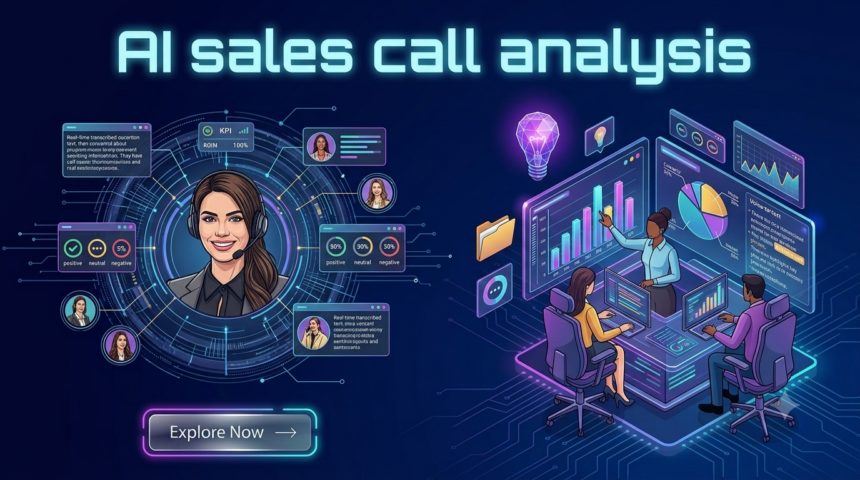
AI sales calls are one of the most important parts of the buying journey. Every conversation between a sales representative and a potential customer contains valuable information. From customer objections and buying signals to competitor mentions and pricing discussions, every detail can influence whether a deal is won or lost.
The challenge is that manually reviewing hundreds of sales calls takes a significant amount of time. Managers often listen to only a small percentage of recorded conversations, meaning valuable coaching opportunities and customer insights can easily be missed.
This is where AI sales call analysis makes a real difference.
Powered by artificial intelligence, modern sales call analysis tools automatically record, transcribe, and analyze conversations. They identify key topics, detect customer sentiment, highlight important moments, and provide actionable recommendations that help sales teams improve their performance.
Whether you’re leading a small sales team or managing a large enterprise, AI can reduce manual work while helping representatives close more deals through data-driven coaching.

In this guide, you’ll learn how AI sales call analysis works, its biggest advantages, the best tools available, essential features to consider, and whether free or paid solutions are the better choice for your business.
Fast Info Table
| Feature | Details |
|---|---|
| Keyword | AI Sales Call Analysis |
| Category | Artificial Intelligence, Sales Technology |
| Primary Purpose | Analyze sales conversations automatically |
| Main Technology | Artificial Intelligence + Natural Language Processing (NLP) |
| Best For | Sales teams, SDRs, BDRs, Account Executives, Sales Managers |
| Key Benefits | Coaching, call scoring, sentiment analysis, conversation insights |
| Popular Integrations | Salesforce, HubSpot, Zoom, Microsoft Teams, Google Meet |
| Pricing | Free plans available; premium plans offer advanced analytics |
| Ideal Business Size | Startups, SMBs, Mid-sized businesses, Enterprises |
What Is AI Sales Call Analysis?
AI sales call analysis is the process of using artificial intelligence to automatically evaluate recorded or live sales conversations. Instead of relying on managers to listen to every call manually, AI software reviews conversations in minutes and generates meaningful insights that help improve sales performance.
These platforms use technologies like speech recognition, natural language processing (NLP), and machine learning to understand what both the salesperson and the customer are saying. The software converts speech into text, identifies important keywords, detects emotions, tracks customer intent, and highlights moments that may require coaching or follow-up.
For example, an AI platform can recognize when a customer repeatedly mentions budget concerns, compares competitors, or expresses strong buying intent. It can also detect whether the salesperson spoke too much, interrupted the customer frequently, or forgot to ask discovery questions.
Instead of simply storing recordings, AI transforms every sales conversation into useful business intelligence.
Why Businesses Are Adopting AI Sales Call Analysis
Companies today generate thousands of customer conversations every month. Reviewing each call manually is nearly impossible.
AI allows organizations to:
- Analyze 100% of recorded sales calls automatically.
- Identify successful sales techniques used by top performers.
- Discover common customer objections.
- Monitor compliance requirements.
- Improve onboarding for new sales representatives.
- Deliver personalized coaching based on real conversations.
- Track performance across the entire sales team.
This data-driven approach enables businesses to make faster, more informed decisions while continuously improving sales outcomes.
Key Technologies Behind AI Sales Call Analysis
Several advanced technologies work together to deliver accurate insights:
Speech-to-Text Conversion
The first step is converting spoken conversations into written transcripts. Modern AI systems provide highly accurate transcriptions, even during fast-paced discussions.
Natural Language Processing (NLP)
NLP enables the AI to understand the meaning of conversations rather than simply recognizing words. It identifies topics, intent, questions, objections, and customer interests.
Sentiment Analysis
AI evaluates the emotional tone of both participants. It can detect confidence, hesitation, frustration, excitement, or uncertainty throughout the conversation.
Conversation Intelligence
Conversation intelligence helps identify patterns across thousands of calls. Sales leaders can see what successful representatives consistently do differently from average performers.
Machine Learning
As more conversations are analyzed, machine learning models continuously improve their ability to recognize sales patterns, customer behaviors, and successful communication strategies.
Common Use Cases
AI sales call analysis supports many day-to-day sales activities, including:
- Sales coaching
- Performance reviews
- Customer sentiment tracking
- Quality assurance
- Compliance monitoring
- Objection handling analysis
- Sales training
- Competitive intelligence
- Forecast accuracy
- Deal risk identification
Because the AI processes every conversation consistently, managers gain a complete picture of team performance rather than relying on random call samples.
Who Should Use AI Sales Call Analysis?
This technology is valuable for organizations of nearly every size, including:
- Sales representatives looking to improve conversion rates.
- Sales managers responsible for coaching teams.
- Customer success teams managing client relationships.
- Inside sales organizations handling high call volumes.
- B2B companies with complex sales cycles.
- SaaS businesses focused on recurring revenue.
- Call centers seeking better quality assurance.
- Enterprise organizations managing distributed sales teams.
Whether your team handles 20 calls a week or thousands each day, AI sales call analysis provides insights that would be difficult—and often impossible—to uncover manually.
How AI Sales Call Analysis Works
AI sales call analysis follows a structured process that transforms ordinary conversations into meaningful insights. Instead of simply recording calls, AI evaluates every interaction and highlights patterns that help sales teams improve performance.
Here’s how the process typically works.
1. Call Recording
Everything starts with a sales conversation.
The AI platform records calls from popular communication tools such as Zoom, Microsoft Teams, Google Meet, VoIP systems, or traditional phone calls. Many platforms also support mobile conversations and automatically sync recordings with your CRM.
This ensures every customer interaction is captured without requiring manual uploads.
2. Speech-to-Text Transcription
Once the call ends—or even during a live conversation—the AI converts spoken words into accurate text.
Modern transcription technology recognizes multiple speakers, identifies who is talking, and creates searchable transcripts within minutes.
Instead of listening to a 45-minute recording, sales managers can search the transcript for phrases like:
- “Too expensive”
- “Need approval”
- “Competitor”
- “Next meeting”
This saves valuable time and makes reviewing conversations much easier.
3. Speaker Identification
A quality AI sales call analysis platform separates each speaker automatically.
For example:
Sales Representative: Can I ask what challenges you’re currently facing?
Customer: We’re struggling with slow response times and outdated software.
By identifying each participant correctly, AI measures important conversation metrics such as:
- Talk-to-listen ratio
- Number of interruptions
- Question frequency
- Customer engagement
- Response times
These insights help managers coach representatives more effectively.
4. Natural Language Processing (NLP)
Natural Language Processing (NLP) enables AI to understand the meaning behind conversations rather than simply recognizing words.
The software identifies:
- Customer pain points
- Buying signals
- Product interest
- Pricing discussions
- Competitor mentions
- Objections
- Decision-maker references
- Follow-up commitments
For example, if a customer says,
“We’re planning to purchase within the next two months.”
The AI recognizes this as a strong buying signal rather than just another sentence in the transcript.
5. Sentiment Analysis
One of the most valuable capabilities of AI is sentiment analysis.
The software evaluates emotional tone throughout the conversation and detects whether the customer sounds:
- Interested
- Confident
- Excited
- Frustrated
- Confused
- Hesitant
- Positive
- Negative
Instead of relying on assumptions, managers receive measurable data about customer reactions during each stage of the sales process.
If customer sentiment suddenly becomes negative after pricing is discussed, sales leaders can quickly identify where conversations begin to lose momentum.
6. Keyword and Topic Detection
AI automatically recognizes frequently mentioned words and important discussion topics.
Common examples include:
- Budget
- Pricing
- Contract
- Integration
- Security
- Support
- ROI
- Implementation
- Timeline
- Competitor names
This allows businesses to discover recurring customer concerns and identify opportunities for improving sales messaging.
7. Call Scoring
Many AI platforms automatically score each sales conversation.
Instead of subjective evaluations, AI measures performance using predefined criteria such as:
- Greeting quality
- Discovery questions
- Product knowledge
- Objection handling
- Active listening
- Next-step confirmation
- Closing technique
- Compliance requirements
Managers receive consistent evaluations across every representative.
8. Actionable Recommendations
After completing the analysis, AI generates recommendations designed to improve future conversations.
Examples include:
- Ask more open-ended questions.
- Reduce talking time.
- Address pricing concerns earlier.
- Improve objection handling.
- Schedule follow-up meetings sooner.
- Personalize product demonstrations.
- Mention customer success stories more often.
These suggestions help sales representatives continuously improve without waiting for manual coaching sessions.
Benefits of AI Sales Call Analysis
Businesses are adopting AI sales call analysis because it provides measurable improvements across the entire sales process.
Here are some of the biggest advantages.
1. Improves Sales Coaching
Traditional coaching depends on managers manually reviewing a small number of calls.
With AI, every conversation becomes a coaching opportunity.
Managers can identify exactly where representatives succeed and where they need improvement, making coaching sessions more objective and productive.
Instead of offering general advice, coaches can reference specific moments from actual customer conversations.
2. Saves Valuable Time
Listening to dozens of recorded calls every week isn’t practical.
AI completes the same work in minutes.
Sales managers can quickly review summaries, key highlights, sentiment reports, and performance metrics without spending hours replaying recordings.
The time saved can be invested in coaching, strategy, and customer engagement.
3. Increases Win Rates
Successful sales conversations often follow similar patterns.
AI identifies these winning behaviors by analyzing top-performing representatives and comparing them with lower-performing team members.
Businesses can then replicate proven techniques across the entire organization, leading to higher conversion rates and more closed deals.
4. Identifies Customer Pain Points
Customers frequently reveal valuable information during conversations.
They may discuss:
- Budget limitations
- Operational challenges
- Existing software problems
- Security concerns
- Integration needs
- Business goals
AI automatically captures these insights, helping sales teams better understand customer needs and tailor future conversations.
5. Enhances Customer Experience
Great customer experiences begin with better communication.
AI helps representatives:
- Listen more carefully.
- Avoid interrupting customers.
- Ask better discovery questions.
- Respond with greater accuracy.
- Personalize conversations.
As a result, customers feel heard, understood, and valued throughout the buying journey.
6. Improves Sales Training
New sales representatives often require weeks—or even months—to become fully productive.
AI accelerates onboarding by providing access to successful conversations, common objections, and proven responses.
New hires can learn directly from top-performing representatives instead of relying solely on classroom-style training.
7. Supports Better Forecasting
Buying signals often appear long before a deal closes.
AI detects indicators such as:
- Purchase intent
- Budget approval
- Decision-maker involvement
- Timeline discussions
- Follow-up commitments
These insights allow sales leaders to make more accurate revenue forecasts based on actual customer conversations rather than intuition alone.
8. Ensures Compliance
Industries such as finance, healthcare, and insurance must follow strict communication regulations.
AI automatically monitors conversations for required disclosures, prohibited language, and compliance violations.
This reduces legal risks while helping organizations maintain consistent standards.
9. Reveals Market Trends
Thousands of customer conversations contain valuable market intelligence.
AI identifies recurring themes such as:
- Frequently requested features
- Emerging customer needs
- Competitor comparisons
- Pricing concerns
- Industry challenges
Marketing, product, and leadership teams can use these insights to improve products, messaging, and business strategy.
10. Helps Managers Make Data-Driven Decisions
Rather than relying on assumptions, managers gain access to real performance metrics.
They can easily identify:
- Top-performing representatives
- Common objections
- Successful closing strategies
- Coaching opportunities
- Team-wide trends
- Customer satisfaction patterns
This leads to smarter decisions and continuous improvement across the sales organization.
Why AI Sales Call Analysis Is Becoming Essential
Modern sales teams generate enormous amounts of conversation data every day. Without AI, much of that valuable information goes unused.
AI sales call analysis transforms every customer interaction into actionable insights. Instead of guessing what works, businesses can rely on real data to improve coaching, refine sales strategies, strengthen customer relationships, and drive better results.
As artificial intelligence continues to evolve, sales call analysis is becoming a core tool for organizations that want to increase efficiency, improve team performance, and stay competitive in today’s fast-moving marketplace.
Best AI Sales Call Analysis Tools
Choosing the right AI sales call analysis platform depends on your business size, budget, and sales process. Some tools focus on conversation intelligence, while others combine call analysis with CRM integration, coaching, and revenue forecasting.
Below are some of the best AI sales call analysis tools available today.
1. Gong
Gong is one of the most popular conversation intelligence platforms used by enterprise sales teams. It automatically records, transcribes, and analyzes customer conversations to uncover insights that help teams close more deals.
Key Features
- AI-powered conversation analysis
- Automatic call recording and transcription
- Deal risk detection
- Sales coaching insights
- CRM integration
- Revenue intelligence dashboard
Best For
Large organizations and enterprise sales teams.
Pros
- Highly accurate AI insights
- Excellent coaching recommendations
- Powerful analytics dashboard
- Strong CRM integrations
Cons
- Premium pricing
- May offer more features than small businesses need
2. Chorus by ZoomInfo
Chorus helps sales teams improve performance by analyzing customer interactions across calls, emails, and meetings. It highlights important moments and provides managers with coaching opportunities.
Key Features
- Conversation intelligence
- Call summaries
- Sentiment tracking
- Keyword monitoring
- Performance scorecards
- CRM synchronization
Best For
Growing B2B sales teams.
Pros
- Easy-to-use interface
- Strong reporting features
- Helpful coaching insights
- Accurate conversation tracking
Cons
- Advanced features require higher-tier plans.
3. Fireflies.ai
Fireflies.ai is an AI meeting assistant that automatically records, transcribes, and summarizes meetings. It supports multiple video conferencing platforms and offers collaboration tools for teams.
Key Features
- Automatic meeting transcription
- AI-generated summaries
- Searchable conversation history
- Task extraction
- Team collaboration
- Integrations with popular business apps
Best For
Small businesses, startups, and remote teams.
Pros
- User-friendly interface
- Affordable pricing
- Supports many meeting platforms
- Quick meeting summaries
Cons
- Sales analytics are less advanced than enterprise-focused platforms.
4. Avoma
Avoma combines meeting intelligence with AI coaching and customer collaboration. It helps sales teams prepare for meetings, capture notes automatically, and improve follow-up activities.
Key Features
- AI meeting notes
- Conversation analytics
- Sales coaching
- Agenda management
- CRM integration
- Follow-up recommendations
Best For
Sales teams that want both meeting management and conversation intelligence.
Pros
- Excellent meeting organization
- Easy note sharing
- Strong productivity features
- Helpful follow-up reminders
Cons
- Some advanced analytics require premium plans.
5. Salesloft Conversation Intelligence
Salesloft offers conversation intelligence as part of its sales engagement platform. It provides AI-driven coaching, performance tracking, and deal analysis.
Key Features
- Conversation scoring
- Coaching recommendations
- Keyword tracking
- Deal insights
- CRM integration
- Sales engagement tools
Best For
Organizations already using the Salesloft ecosystem.
Pros
- Comprehensive sales platform
- Strong coaching capabilities
- Excellent reporting
- Workflow automation
Cons
- Best value comes when using the full Salesloft platform.
6. Clari Copilot
Clari Copilot helps revenue teams understand customer conversations and identify potential risks before deals are lost.
Key Features
- AI call analysis
- Revenue forecasting
- Customer sentiment tracking
- Sales coaching
- CRM synchronization
- Pipeline visibility
Best For
Revenue operations teams and enterprise businesses.
Pros
- Excellent forecasting features
- Strong conversation intelligence
- Easy dashboard navigation
- Reliable AI insights
Cons
- Pricing may be higher for smaller businesses.
7. MeetGeek
MeetGeek is an AI meeting assistant designed to record, summarize, and organize meetings automatically. It helps teams stay organized while reducing manual note-taking.
Key Features
- Meeting transcription
- AI summaries
- Action item tracking
- Meeting highlights
- Calendar integration
- Collaboration tools
Best For
Freelancers, startups, and small teams.
Pros
- Affordable plans
- Simple interface
- Fast meeting summaries
- Easy collaboration
Cons
- Limited advanced sales analytics.
Comparison Table
| Tool | Best For | AI Transcription | Coaching | CRM Integration |
|---|---|---|---|---|
| Gong | Enterprise Sales | ✅ | ✅ | ✅ |
| Chorus | B2B Sales Teams | ✅ | ✅ | ✅ |
| Fireflies.ai | Small Businesses | ✅ | Limited | ✅ |
| Avoma | Meeting Intelligence | ✅ | ✅ | ✅ |
| Salesloft | Sales Engagement | ✅ | ✅ | ✅ |
| Clari Copilot | Revenue Teams | ✅ | ✅ | ✅ |
| MeetGeek | Small Teams | ✅ | Limited | Limited |
Features to Look For
Not every AI sales call analysis platform offers the same capabilities. Before investing in a solution, consider the features that will provide the greatest value to your sales team.
Accurate Speech Recognition
High-quality transcription is the foundation of effective call analysis. Choose software that accurately converts conversations into searchable text, even when multiple speakers or different accents are involved.
Conversation Intelligence
The best tools do more than create transcripts. They identify buying signals, objections, customer intent, competitor mentions, pricing discussions, and important topics that influence sales outcomes.
Sentiment Analysis
Understanding customer emotions can reveal whether prospects are engaged, hesitant, or dissatisfied. Sentiment analysis helps sales representatives adjust their approach and improve future conversations.
AI Call Summaries
Instead of reading lengthy transcripts, AI-generated summaries provide a quick overview of each conversation. Look for tools that highlight key discussion points, decisions made, action items, and follow-up tasks.
Sales Coaching
Effective platforms provide personalized coaching recommendations based on real conversations. Features such as talk-to-listen ratios, interruption tracking, and question analysis help representatives continuously improve.
CRM Integration
A good AI sales call analysis tool should integrate seamlessly with popular CRM systems like Salesforce, HubSpot, and other sales platforms. This keeps customer records updated automatically and reduces manual data entry.
Keyword Tracking
Keyword tracking enables managers to monitor important terms such as pricing, competitors, discounts, contracts, or product features. It also helps identify recurring customer concerns across multiple conversations.
Performance Dashboards
Interactive dashboards make it easier to track sales performance, coaching progress, call quality, and overall team productivity. Clear visual reports allow managers to identify trends quickly and make informed decisions.
Security and Compliance
If your business handles sensitive customer information, prioritize platforms with strong security features such as data encryption, role-based access, and compliance with industry standards like GDPR or SOC 2.
Automation Features
Automation saves valuable time by handling repetitive tasks, including:
- Call recording
- Meeting transcription
- Note generation
- Follow-up reminders
- CRM updates
- Action item creation
Free vs Paid Tools
When choosing an AI sales call analysis solution, one of the biggest decisions is whether a free plan is enough or if investing in a paid platform will deliver better value.
Free tools are a great starting point for freelancers, startups, and small businesses. They usually include basic features such as meeting recording, AI transcription, and limited summaries. Paid tools, however, offer advanced conversation intelligence, coaching, CRM integrations, and analytics that can significantly improve sales performance.
Free AI Sales Call Analysis Tools
Free plans are ideal if you’re just beginning to explore AI-powered sales technology or have a limited budget.
Advantages
- No upfront cost
- Easy to get started
- Basic transcription and meeting summaries
- Suitable for individuals and small teams
- Opportunity to test AI features before upgrading
Limitations
- Monthly usage limits
- Fewer integrations
- Basic reporting
- Limited AI insights
- Restricted storage and collaboration features
Paid AI Sales Call Analysis Tools
Paid solutions are designed for businesses that rely heavily on sales calls and want detailed insights to improve team performance.
Advantages
- Unlimited or higher call processing limits
- Advanced conversation intelligence
- Sentiment analysis
- AI-powered coaching
- CRM synchronization
- Custom dashboards
- Compliance monitoring
- Better security and customer support
Potential Drawbacks
- Monthly or annual subscription costs
- Some enterprise platforms require custom pricing
- Advanced features may have a learning curve
Which Option Is Right for You?
The right choice depends on your business needs.
- Freelancers and consultants can often manage with a free or entry-level plan.
- Startups benefit from affordable paid plans that include CRM integration and coaching.
- Small and medium-sized businesses should consider paid tools for better analytics and team management.
- Large enterprises usually gain the most value from comprehensive platforms with advanced AI insights, forecasting, and compliance features.
As your sales team grows, upgrading to a paid solution can improve productivity, enhance coaching, and help close more deals.
Frequently Asked Questions (FAQs)
1. What is AI sales call analysis?
AI sales call analysis uses artificial intelligence to record, transcribe, and evaluate sales conversations. It identifies customer sentiment, buying signals, objections, keywords, and coaching opportunities, helping sales teams improve performance and make data-driven decisions.
2. Can AI analyze live sales calls?
Yes. Many modern AI platforms analyze conversations in real time or immediately after a call ends. Some tools even provide live prompts, reminders, and suggestions to help sales representatives respond more effectively during customer conversations.
3. Is AI sales call analysis suitable for small businesses?
Absolutely. Many AI-powered tools offer affordable plans designed for startups and small businesses. These solutions can save time, improve sales coaching, and provide valuable customer insights without requiring a large budget.
4. Does AI sales call analysis integrate with CRM software?
Most leading platforms integrate with popular CRM systems such as Salesforce, HubSpot, Microsoft Dynamics, and other sales tools. These integrations automatically update customer records, synchronize call notes, and streamline sales workflows.
Conclusion
AI sales call analysis is transforming the way businesses understand and improve customer conversations. Instead of manually reviewing recordings, sales teams can use artificial intelligence to analyze every call, identify patterns, and uncover valuable insights in just minutes.
From automatic transcription and sentiment analysis to coaching recommendations and CRM integration, AI-powered platforms help organizations increase efficiency while giving managers the information they need to support their teams more effectively. Representatives also benefit from personalized feedback, enabling them to refine their communication skills, handle objections with greater confidence, and build stronger relationships with potential customers.
Whether you’re a freelancer, a growing startup, or a large enterprise, implementing AI sales call analysis can lead to smarter decisions, improved customer experiences, and higher conversion rates. As AI technology continues to evolve, businesses that embrace these tools will be better positioned to stay competitive, optimize their sales strategies, and drive long-term growth.
If you’re looking to improve sales performance, reduce manual work, and gain deeper insights into every customer interaction, AI sales call analysis is an investment worth considering.