

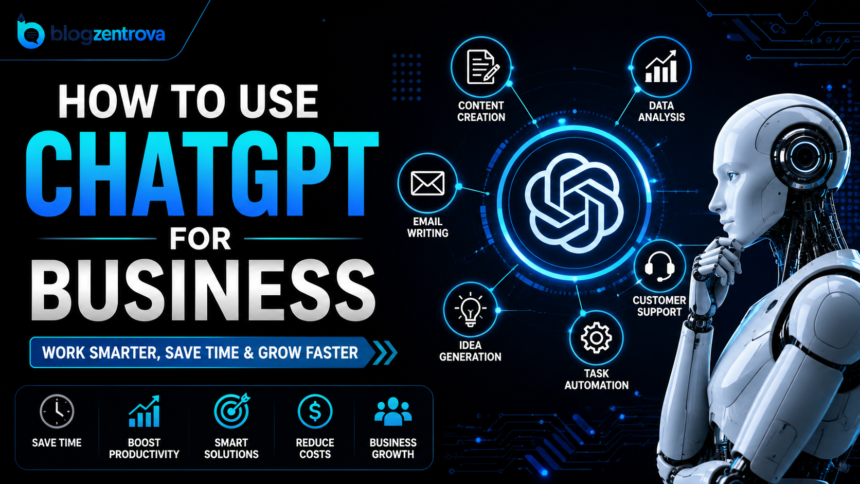
What Is ChatGPT for Business?
Businesses today are always looking for smarter ways to save time, reduce costs, and improve productivity. This is where ChatGPT has become a valuable tool. Whether you’re running a small online store, managing a startup, or leading a growing company, ChatGPT can help simplify many everyday tasks.
ChatGPT is an AI-powered assistant developed by OpenAI that understands natural language and generates human-like responses. Instead of spending hours writing emails, creating marketing content, brainstorming ideas, or answering customer questions, businesses can complete many of these tasks in minutes.
The best part is that you don’t need technical knowledge to start using it. Simply type your request, and ChatGPT provides helpful suggestions, drafts, or complete content based on your instructions.
From marketing teams to customer support departments, businesses across different industries are using ChatGPT to improve efficiency and focus more on strategic work instead of repetitive tasks.
Fast Info Table
| Feature | Details |
|---|---|
| Keyword | How to Use ChatGPT for Business |
| Tool | ChatGPT |
| Best For | Small businesses, startups, freelancers, agencies, enterprises |
| Main Purpose | Improve productivity and automate daily business tasks |
| Common Uses | Email writing, customer support, SEO, marketing, content creation, brainstorming |
| Skill Required | Beginner-friendly |
| Pricing | Free and Paid plans available |
| Time Saved | Several hours each week |
| Industries | E-commerce, healthcare, education, finance, marketing, IT, real estate, consulting |
| Best For Teams | Yes |
Why Businesses Are Using ChatGPT
Artificial intelligence has become part of everyday business operations. Companies are no longer using AI only for large-scale automation. Instead, they how to use chatgpt for business are adopting practical AI tools like ChatGPT to complete routine tasks more efficiently. Microsoft also offers AI features through Microsoft 365 Copilot for email, documents, and meetings.

Here are some reasons businesses are embracing ChatGPT:
- Saves valuable time
- Reduces repetitive work
- Helps teams write better content
- Improves customer communication
- Generates creative ideas quickly
- Supports marketing campaigns
- Assists with research
- Increases employee productivity
Instead of replacing employees, ChatGPT works as an assistant that helps teams complete tasks faster while allowing people to focus on more important responsibilities.
For small businesses with limited staff, this can make a significant difference in daily operations.
Top Benefits of Using ChatGPT for Business
Using ChatGPT effectively can improve almost every department within a business. Here are the biggest advantages.
1. Saves Time Every Day
Many business tasks involve writing, editing, researching, or organizing information. These activities often consume several hours.
With ChatGPT, you can:
- Draft emails in minutes
- Create meeting summaries
- Write reports
- Generate proposals
- Prepare presentations
- Answer common customer questions
This allows employees to spend more time on work that requires human decision-making.
2. Improves Content Creation
Content marketing is one of the most time-consuming parts of running a business.
ChatGPT helps generate:
- Blog posts
- Website copy
- Product descriptions
- Landing pages
- Social media captions
- Ad copy
- Video scripts
- Newsletter content
Instead of starting with a blank page, how to use chatgpt for business can use ChatGPT to create a strong first draft and then customize it to match their brand voice.
3. Enhances Customer Support
Customers expect quick responses.
Businesses can use ChatGPT to:
- Draft customer replies
- Create FAQ pages
- Build chatbot responses
- Explain refund policies
- Answer product-related questions
- Write professional support emails
This helps maintain consistent communication while reducing response times.
4. Boosts Marketing Performance
Marketing requires constant creativity.
ChatGPT can assist with:
- Campaign ideas
- Email marketing
- Promotional offers
- SEO content
- Keyword ideas
- Call-to-action suggestions
- Marketing strategies
- Audience research
Marketing teams often use ChatGPT as a brainstorming partner before launching campaigns.
5. Helps Improve SEO
Search engine optimization involves multiple tasks, including keyword research, content planning, and optimization.
Businesses can use ChatGPT to:
- Generate article outlines
- Suggest blog topics
- Improve headings
- Write meta descriptions
- Create title ideas
- Organize content logically
- Answer common customer questions
While manual optimization is still important, ChatGPT speeds up the writing process considerably.
6. Supports Better Decision Making
Business owners frequently need to compare ideas, analyze situations, and evaluate options.
ChatGPT can help by:
- Summarizing lengthy reports
- Comparing products
- Listing pros and cons
- Organizing research
- Explaining industry trends
- Breaking down complex topics
Although important decisions should how to use chatgpt for business always involve human judgment, ChatGPT can make the research process much faster.
7. Reduces Business Costs
Hiring specialists for every small task isn’t always possible, especially for startups and small businesses.
ChatGPT can assist with:
- Drafting marketing copy
- Writing emails
- Creating social media posts
- Editing documents
- Brainstorming business ideas
- Preparing presentations
This helps businesses accomplish more without significantly increasing expenses.
8. Encourages Creativity
Sometimes the biggest challenge isn’t writing—it’s coming up with ideas.
ChatGPT can generate ideas for:
- New products
- Business names
- Marketing campaigns
- Blog topics
- Brand slogans
- Customer engagement activities
- Seasonal promotions
Business owners often use ChatGPT to overcome creative blocks and explore fresh perspectives.
Best Ways to Use ChatGPT for Business
One of the greatest strengths of ChatGPT is its flexibility. It can support nearly every department within a business, regardless of company size.
Here are some of the most effective ways businesses are using ChatGPT today.
1. Customer Service
Providing excellent customer support is essential for building trust and retaining customers.
Businesses can use ChatGPT to:
- Draft support emails
- Respond to customer inquiries
- Create knowledge base articles
- Develop FAQ sections
- Write chatbot conversations
- Explain return and refund policies
This ensures customers receive clear and professional communication while reducing the workload on support teams.
2. Email Writing
Professional communication is a daily requirement for businesses.
ChatGPT can help create:
- Sales emails
- Follow-up emails
- Welcome emails
- Customer support responses
- Internal announcements
- Partnership proposals
- Appointment confirmations
Instead of spending time rewriting emails, employees can edit AI-generated drafts and send them more quickly.
3. Content Marketing
Content remains one of the most effective ways to attract potential customers online.
Businesses use ChatGPT to create:
- SEO blog posts
- Website pages
- Case studies
- Press releases
- Product guides
- Video scripts
- Email newsletters
Best Ways to Use ChatGPT for Business (Continued)
4. Social Media Marketing
Maintaining an active social media presence takes time and creativity. ChatGPT can make the process much easier by helping businesses create engaging content for different platforms. how to use chatgpt for business
You can use ChatGPT to:
- Write Facebook posts
- Create Instagram captions
- Generate LinkedIn content
- Draft X (formerly Twitter) posts
- Suggest YouTube video ideas
- Plan a monthly content calendar
- Write engaging call-to-actions
- Generate hashtag ideas
For example, if you’re launching a new product, ChatGPT can generate multiple caption ideas with different tones, such as professional, friendly, or promotional.
5. Sales and Lead Generation
Every business needs a steady flow of customers. ChatGPT can support your sales team by helping create persuasive and personalized content.
Common sales tasks include:
- Writing cold emails
- Creating follow-up messages
- Preparing sales pitches
- Writing product descriptions
- Generating proposals
- Creating promotional offers
- Drafting client presentations
While ChatGPT doesn’t replace your sales team, it helps them communicate more efficiently and professionally.
6. HR and Recruitment
Hiring the right employees involves writing job descriptions, screening candidates, and communicating throughout the recruitment process.
ChatGPT can assist by creating:
- Job descriptions
- Interview questions
- Employee handbooks
- Training materials
- Welcome emails
- Performance review templates
- Internal policy documents
It can also help HR teams simplify complex policies into language that’s easier for employees to understand.
7. Research and Data Analysis
Business owners often spend hours researching competitors, market trends, or customer feedback.
ChatGPT can help by:
- Summarizing reports
- Explaining technical concepts
- Organizing research notes
- Comparing products or services
- Identifying strengths and weaknesses
- Creating SWOT analyses
- Suggesting business improvements
Although ChatGPT should not be your only source for business decisions, it can significantly reduce the time needed to process information.
8. Meeting Notes and Summaries
Long meetings often produce pages of notes that need to be organized and shared with the team.
ChatGPT can:
- Summarize meeting discussions
- Highlight key decisions
- Create action items
- Organize project updates
- Prepare meeting agendas
- Write follow-up emails
This helps everyone stay aligned without spending extra time reviewing lengthy notes.
9. Brainstorming Business Ideas
Every business experiences moments when fresh ideas are needed. Whether you’re launching a new service or planning a marketing campaign, ChatGPT can help spark creativity.
You can ask it to generate:
- Product ideas
- Business names
- Marketing slogans
- Campaign concepts
- Blog topics
- Customer loyalty programs
- Seasonal promotions
- Partnership opportunities
Think of ChatGPT as a brainstorming partner that provides inspiration whenever you need it.
How to Use ChatGPT for Business (Step-by-Step Guide)
If you’re new to ChatGPT, getting started is simple. Follow these steps to use it effectively in your business.
Step 1: Identify Repetitive Tasks
Begin by listing tasks that consume a lot of time each week.
Examples include:
- Writing emails
- Creating blog posts
- Responding to customers
- Posting on social media
- Writing reports
- Preparing presentations
- Creating product descriptions
These repetitive tasks are excellent candidates for AI assistance.
Step 2: Write Clear Prompts
The quality of ChatGPT’s response depends on the quality of your prompt.
Instead of writing:
“Write an email.”
Try something more specific:
“Write a professional follow-up email to a customer who requested pricing for our digital marketing services.”
The more context you provide, the more accurate and useful the output will be.
Step 3: Review and Personalize the Response
Never copy and paste AI-generated content without reviewing it.
Take time to:
- Check facts
- Correct any errors
- Add your brand voice
- Include company-specific information
- Adjust the tone for your audience
Human editing ensures the final content feels authentic and aligns with your business goals.
Step 4: Use ChatGPT Across Multiple Departments
ChatGPT isn’t just for marketing. Encourage different teams to explore how it can improve their workflows.
For example:
| Department | How ChatGPT Helps |
|---|---|
| Marketing | Blog writing, SEO, ads, social media |
| Sales | Email outreach, proposals, sales scripts |
| Customer Support | FAQs, email replies, chatbot responses |
| Human Resources | Job descriptions, onboarding materials |
| Finance | Report summaries, document explanations |
| Operations | SOPs, meeting notes, workflow documentation |
Using ChatGPT across departments can increase overall efficiency and collaboration.
Step 5: Save Your Best Prompts
Once you find prompts that consistently produce great results, save them for future use.
Create a prompt library with categories such as:
- Marketing prompts
- SEO prompts
- Customer support prompts
- Sales prompts
- HR prompts
- Content writing prompts
This saves time and helps maintain consistency across your business.
Step 6: Protect Sensitive Information
When using AI tools, avoid entering confidential or sensitive business information unless you’re using an environment designed for that purpose.
Avoid sharing:
- Customer passwords
- Credit card details
- Private contracts
- Financial records
- Personal employee information
- Confidential business strategies
Protecting sensitive data should always be a priority.
Best ChatGPT Prompts for Business
The right prompts can dramatically improve the quality of AI-generated content. Here are some practical examples you can adapt for your business.
Marketing Prompt
“Create a one-month social media content calendar for a digital marketing agency targeting small business owners.”
SEO Prompt
“Write an SEO-friendly blog outline for the keyword ‘how to use ChatGPT for business‘ with H2 and H3 headings.”
Customer Support Prompt
“Write a polite response to a customer requesting a refund due to delayed delivery.”
Sales Prompt
“Create a persuasive follow-up email for a customer who downloaded our pricing guide but hasn’t responded.”
HR Prompt
“Write a job description for a remote customer support representative with two years of experience.”
Business Strategy Prompt
“Suggest five low-cost marketing strategies for a local retail business with a limited budget.”
Product Description Prompt
“Write a compelling product description for a wireless Bluetooth keyboard aimed at remote workers.”
Meeting Summary Prompt
“Summarize the following meeting notes into key decisions, action items, and deadlines.”
Blog Writing Prompt
“Write a beginner-friendly blog introduction explaining how small businesses can use ChatGPT to improve productivity.”
Email Prompt
“Write a professional email announcing a new service launch to existing customers.”
ChatGPT Free vs Paid for Business
Choosing between the free and paid versions of ChatGPT depends on your business needs. Many small businesses start with the free version, while growing teams often benefit from the additional features available in paid plans.
Feature Free Version Paid Version Basic AI assistance ✅ ✅ Faster response times ❌ ✅ Access during peak hours Limited ✅ More advanced AI models Limited ✅ Better reasoning and writing quality Good Excellent Longer conversations Limited ✅ Suitable for teams Basic Better for professional use If you only need occasional help with emails, brainstorming, or simple content creation, the free version may be enough. However, businesses that rely on AI every day for marketing, customer support, or documentation may find the paid version a worthwhile investment.
Tips to Get Better Results with ChatGPT
To get the most value from ChatGPT, it’s important to use it strategically rather than expecting perfect results from a single prompt.
Be Specific
Detailed prompts usually produce better responses.
Instead of asking:
“Write a blog.”
Try:
“Write a 1,500-word beginner-friendly blog about how small businesses can use ChatGPT for customer support.”
Provide Context
Tell ChatGPT about your audience, goals, industry, and preferred tone.
For example:
- Target audience
- Brand voice
- Product or service
- Desired word count
- Writing style
- Call-to-action
The more context you provide, the more relevant the output will be.
Edit Before Publishing
AI-generated content should always be reviewed by a human.
Check for:
- Accuracy
- Grammar
- Brand consistency
- Updated information
- Readability
- SEO optimization
A quick review helps ensure the final content reflects your business accurately.
Experiment with Different Prompts
If the first response isn’t exactly what you need, refine your prompt instead of starting over.
You can ask ChatGPT to:
- Make it shorter
- Add examples
- Use simpler language
- Change the tone
- Include statistics
- Rewrite for beginners
This iterative approach often leads to much stronger results.
Combine AI with Human Expertise
ChatGPT works best as a productivity tool—not a replacement for human knowledge and judgment.
Use AI to:
- Generate ideas
- Draft content
- Organize information
- Speed up routine tasks
Then apply your expertise to verify facts, add unique insights, and make the final decisions.
Common Mistakes to Avoid
Many businesses start using AI without a clear process. Avoid these common pitfalls to get better outcomes.
1. Using Very Short Prompts
One-line prompts often lead to generic answers. Provide clear instructions and enough detail for the AI to understand your goal.
2. Publishing Without Reviewing
Always proofread and fact-check AI-generated content before publishing it. This helps prevent errors and ensures the content matches your brand voice.
3. Sharing Sensitive Information
Avoid entering confidential business information, customer data, financial records, passwords, or private documents into AI tools unless you’re using an approved, secure environment designed for that purpose.
4. Expecting AI to Replace Employees
ChatGPT is designed to assist people, not replace them. Human creativity, critical thinking, and decision-making remain essential for running a successful business.
5. Ignoring SEO Best Practices
If you’re using ChatGPT for blog writing, remember to:
- Use your focus keyword naturally.
- Write clear headings.
- Add internal and external links.
- Optimize images with descriptive alt text.
- Include a compelling meta title and description.
These steps help improve your content’s visibility in search engines.
Frequently Asked Questions (FAQs)
1. How can small businesses use ChatGPT?
Small businesses can use ChatGPT to write emails, create blog posts, manage social media content, generate marketing ideas, draft product descriptions, prepare customer support responses, and streamline everyday administrative tasks.
2. Is ChatGPT good for business?
Yes. ChatGPT can improve productivity by helping businesses complete routine writing and research tasks more efficiently. It works best as an assistant that supports employees rather than replacing them.
3. Can ChatGPT help with marketing?
Absolutely. ChatGPT can assist with content marketing, SEO, social media posts, email campaigns, ad copy, content calendars, and brainstorming new campaign ideas.
4. Is the free version of ChatGPT enough for business?
For many freelancers and small businesses, the free version is a good starting point. Companies with higher workloads or more advanced needs may benefit from a paid plan that offers faster performance and access to more capable AI models.
Conclusion
Learning how to use ChatGPT for business can give companies a practical advantage by saving time, improving communication, and increasing productivity. From writing emails and creating marketing content to supporting customer service and organizing business information, ChatGPT can simplify many day-to-day operations.
The most successful businesses use ChatGPT as a collaborative tool. Instead of relying on AI for every decision, they combine its speed with human expertise to produce high-quality work, maintain accuracy, and deliver better experiences for customers.
Whether you’re a freelancer, startup founder, or part of a growing organization, starting with a few simple tasks and gradually expanding your use of ChatGPT can help you work more efficiently and focus on what matters most—growing your business.