


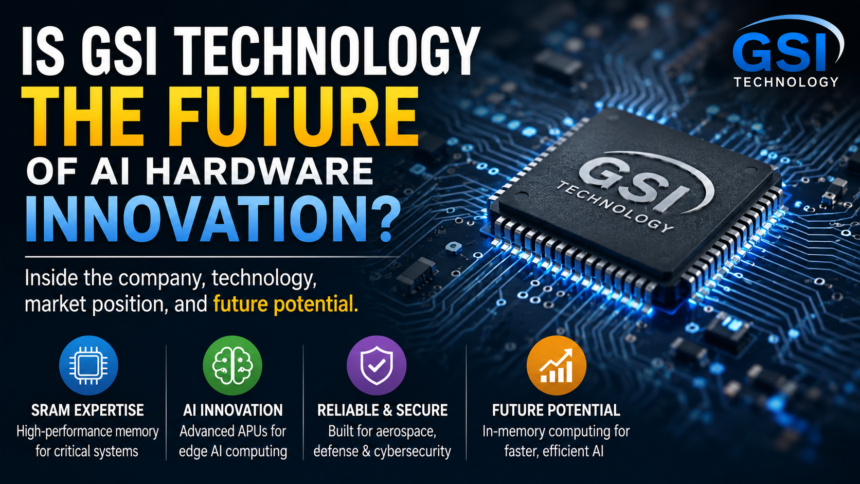
GSI Technology is a U.S.-based semiconductor company that is trying to reshape itself from a traditional memory-chip manufacturer into an AI-focused hardware innovator. The short answer is: it has potential in niche AI and edge computing markets, but it is still an early-stage player compared to giants like NVIDIA and AMD. Its future depends on whether its new AI chip technology can scale commercially and gain real adoption.
The company is working on advanced memory solutions and AI processors that aim to perform data-heavy tasks faster and more efficiently by processing information closer to where it is stored. This approach could make it relevant in the future of AI hardware, especially for specialized applications like defense, cybersecurity, and edge computing.
Fast Info Table
| Feature | Details |
|---|---|
| Company Name | GSI Technology |
| Founded | 1995 |
| Headquarters | Sunnyvale, California, USA |
| CEO | Lee-Lean Shu |
| Industry | Semiconductors, AI Hardware |
| Core Products | SRAM chips, AI processors (APUs) |
| Stock Ticker | GSIT (NASDAQ) |
| Key Focus Shift | AI edge computing & in-memory processing |
Company Background and Business Model
GSI Technology originally built its reputation as a high-performance memory chip company specializing in SRAM (Static Random-Access Memory). These chips are widely used in systems that require ultra-fast and reliable data access, such as networking equipment, aerospace systems, and defense electronics.
Over time, the company realized that the memory market alone was not enough for long-term growth. As a result, it started shifting toward AI-focused hardware solutions. This transition marks a major strategic change in its business model—from a traditional semiconductor supplier to an AI infrastructure innovator.
Today, its business is split between legacy SRAM products and emerging AI processor technologies. While SRAM still generates revenue, the future direction is clearly tied to artificial intelligence and edge computing applications.

SRAM Technology and Core Engineering Strength
The foundation of gsi technology success lies in its SRAM expertise. SRAM is a type of memory that provides extremely fast data access without needing constant refresh cycles, making it ideal for high-speed computing environments.
These chips are widely used in:
- Aerospace and satellite systems
- Military and defense electronics
- Networking and telecom infrastructure
- Medical imaging systems
One of the key advantages of SRAM is its reliability in extreme conditions, including radiation-heavy environments like space. This makes GSI’s products valuable in mission-critical applications where failure is not an option.
However, while SRAM is stable and profitable, it is also a mature and highly competitive market. This is one reason the company is pushing into AI hardware innovation to find new growth opportunities.
AI Transition and Gemini APU Development
The most important shift in GSI Technology’s strategy is its move into AI hardware through its Associative Processing Unit (APU) technology, especially the Gemini platform.
Unlike traditional processors, APUs are designed to perform computations directly within memory. This approach is called compute-in-memory architecture, and it significantly reduces the time and energy required to move data between memory and processors.
Key benefits include:
- Faster AI inference for large datasets
- Lower power consumption compared to GPUs
- Better efficiency for edge AI applications
- Strong performance in vector search and pattern recognition
This makes the technology suitable for applications like cybersecurity threat detection, autonomous systems, and real-time image analysis. However, it is still in early commercialization stages and has not yet reached mass adoption.
Market Position and Competitive Challenges
In the global semiconductor industry, GSI Technology is a small-cap company competing against giants like NVIDIA, AMD, and Intel. These companies dominate AI chip development with massive research budgets and strong market adoption.
Compared to them, GSI Technology faces several challenges:
- Limited revenue scale
- High R&D costs
- Slow commercial rollout of AI chips
- Strong competition in AI accelerator space
However, it also has some unique strengths. Its focus on in-memory computing gives it a different technological approach compared to GPU-based systems. If successful, this could allow it to serve niche markets where efficiency and low power usage matter more than raw computing power.
Investors see it as a high-risk, high-reward innovation play rather than a stable semiconductor leader.
Future Outlook and Innovation Potential
The future of GSI Technology depends heavily on whether its AI hardware strategy can move from research to real-world adoption. The company’s APU technology has strong theoretical advantages, especially for edge AI systems where power efficiency and speed are critical.
If industries like defense, cybersecurity, and industrial automation adopt its solutions, GSI could carve out a valuable niche in the AI hardware ecosystem. However, if commercialization remains slow, it risks staying a small player overshadowed by larger semiconductor companies.
Overall, its innovation direction is promising, but execution will decide its long-term success. The next few years will be critical in determining whether it becomes a meaningful AI hardware competitor or remains a specialized memory-chip company.
Conclusion
GSI Technology is in a transition phase from a memory-focused semiconductor company to an AI hardware innovator. Its SRAM business provides stability, while its APU and in-memory computing technology offer future growth potential.
The company’s success will depend on how well it can commercialize its AI chips and compete in a rapidly evolving semiconductor market. It is not yet a leader in AI hardware, but it is experimenting with technologies that could become important in niche, high-performance computing areas.
FAQs
1. What does GSI Technology do?
It designs SRAM memory chips and is developing AI processors for edge computing and data-intensive applications.
2. Is GSI Technology an AI company?
Partially. It is transitioning from a memory chip company into an AI hardware-focused semiconductor firm.
3. What is the Gemini APU?
It is GSI Technology’s AI processor designed for in-memory computing and fast data processing.
4. Is GSI Technology a good investment?
It is considered a high-risk, high-potential stock due to its early-stage AI technology and small market size