


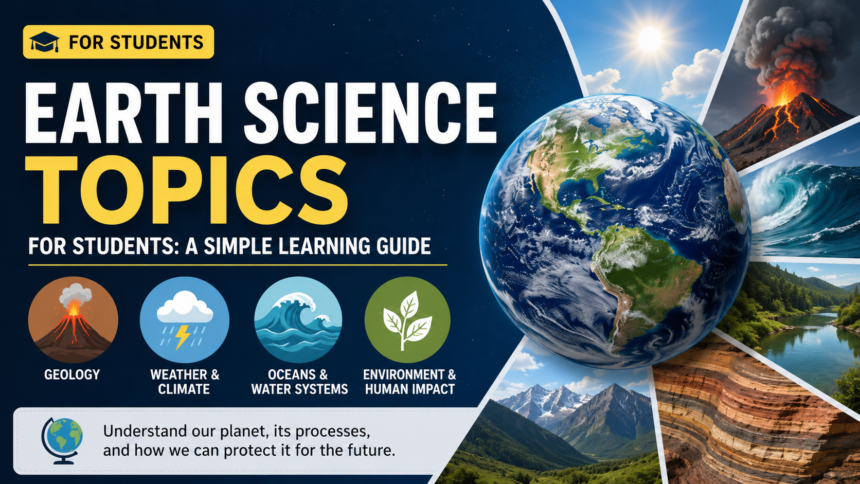
Earth science topics are the main areas of study that explain how our planet works, including its land, water, air, and life systems. These topics help students understand earthquakes, weather, oceans, rocks, climate, and space interactions. In simple terms, earth science topics cover everything about Earth’s structure, processes, and changes over time. They are usually divided into geology, meteorology, oceanography, and environmental science, making it easier for students to study each part of the planet separately while still understanding how everything is connected in one system.
Understanding the Core Areas of Study
Earth science topics begin with understanding Earth as a system made of interconnected parts. The four main branches are geology, meteorology, oceanography, and environmental science. Each branch focuses on a different part of the planet but works together to explain natural processes.
Geology studies rocks, minerals, mountains, and earthquakes. It helps students understand how the Earth was formed and how its surface keeps changing. Meteorology focuses on the atmosphere, weather patterns, rainfall, storms, and climate conditions. Oceanography explores oceans, sea life, currents, and underwater landforms. Environmental science connects all these areas and focuses on human impact, pollution, and sustainability.
For students, learning these branches builds a strong foundation in science. It also improves awareness of real-world issues like natural disasters and climate change. These topics are not just theory; they explain daily life events like rain, heat, floods, and earthquakes in a scientific way.
Earth Structure and Physical Systems
One of the most important earth science topics is the structure of Earth itself. The planet is made of four main layers: crust, mantle, outer core, and inner core. The crust is the thin outer layer where we live. Below it lies the mantle, which is hot and semi-solid. The outer core is made of liquid metal, and the inner core is extremely hot and solid.

These layers are constantly interacting, causing natural events like earthquakes and volcanic eruptions. Plate tectonics is a key concept in this topic. It explains how large plates of Earth’s crust move slowly over time. When they collide or separate, they create mountains, valleys, and ocean trenches.
Students also learn about the rock cycle, which shows how rocks change from one type to another over time. Igneous, sedimentary, and metamorphic rocks are all part of this cycle. Understanding Earth’s structure helps students connect physical changes on the surface with deep internal processes happening below.
Weather, Climate, and Atmospheric Patterns
Another major part of earth science topics is the study of weather and climate. The atmosphere is a layer of gases surrounding Earth, mainly nitrogen and oxygen. It protects life and controls temperature, weather, and air pressure.
Weather refers to short-term conditions like rain, sunshine, wind, and storms. Climate describes long-term patterns in a region. Meteorology helps scientists predict weather using satellites, radar, and computer models.
Students also learn about extreme weather events such as hurricanes, tornadoes, and heatwaves. These events are important because they affect human life, agriculture, and infrastructure. Climate change is another key topic, showing how human activities like pollution and deforestation are changing global temperature patterns.
Understanding weather and climate helps students make sense of daily environmental changes and prepares them to respond to natural disasters more effectively.
Oceans, Water Systems, and Marine Science
Oceans cover about 71% of Earth’s surface, making them a major focus of earth science topics. Oceanography studies everything about oceans, including their movement, composition, and ecosystems.
Ocean currents play a major role in controlling global climate by moving warm and cold water around the planet. These currents affect weather patterns, rainfall, and even fish migration.
Students also learn about marine life and underwater ecosystems such as coral reefs, which are home to thousands of species. The ocean floor has mountains, trenches, and volcanoes, making it as complex as land.
The water cycle is another important concept. It explains how water moves between oceans, atmosphere, and land through evaporation, condensation, and precipitation. This cycle is essential for life on Earth and connects all natural systems together.
Environmental Changes and Human Impact
Earth science topics also include how humans affect the planet. Environmental science studies pollution, deforestation, global warming, and resource use. It helps students understand how human actions can damage or protect Earth systems.
Air pollution from factories and vehicles can harm the atmosphere and contribute to climate change. Deforestation reduces oxygen levels and affects wildlife habitats. Water pollution damages oceans, rivers, and drinking water sources.
Students also learn about renewable energy sources like solar, wind, and hydro power. These alternatives help reduce environmental damage and promote sustainability.
Natural resource management is another key idea. It teaches how to use Earth’s resources wisely without destroying them for future generations. This topic encourages responsible behavior and awareness of environmental protection.
Fast Info Table
| Category | Details |
|---|---|
| Subject Name | Earth Science |
| Main Focus | Study of Earth and its systems |
| Key Branches | Geology, Meteorology, Oceanography, Environmental Science |
| Main Topics | Earth structure, weather, climate, oceans, rocks, space |
| Difficulty Level | Easy to Moderate (for students) |
| Career Options | Geologist, Meteorologist, Environmental Scientist, Oceanographer |
| Importance | Helps understand nature, disasters, and climate change |
| Tools Used | Satellites, maps, sensors, computers, lab testing |
Introduction to Earth Science Topics
Earth science is the study of the Earth and everything connected to it. It combines several scientific fields that focus on different parts of the planet. These include land, water, air, and even Earth’s position in space.
The main goal of studying earth science topics is to understand how natural systems interact. For example, how oceans affect weather, or how tectonic movements cause earthquakes.
Earth science is widely taught in schools because it builds a foundation for understanding environmental changes and natural disasters.
Geology – The Study of Earth’s Structure
Geology is one of the most important earth science topics. It focuses on the solid part of Earth—rocks, minerals, and the layers beneath the surface.
Key areas in geology:
- Formation of rocks (igneous, sedimentary, metamorphic)
- Plate tectonics and continental drift
- Earthquakes and volcanoes
- Mountain formation
Geology helps scientists understand how Earth has changed over millions of years. It also plays a role in finding natural resources like oil, gas, and minerals.
Meteorology – Weather and Atmosphere
Meteorology is the study of weather and the atmosphere. It is another major part of earth science topics because it explains daily weather patterns and long-term climate trends.
What meteorologists study:
- Temperature, humidity, and air pressure
- Rain, storms, and snowfall
- Hurricanes and tornadoes
- Climate change and global warming
Meteorology is important for weather forecasting, which helps people prepare for natural events like storms and heatwaves.
Oceanography – Study of Oceans
Oceanography focuses on Earth’s oceans and seas. Since oceans cover more than 70% of the planet, this is a key area in earth science topics.
Oceanography includes:
- Ocean currents and waves
- Marine life ecosystems
- Sea level changes
- Deep ocean exploration
Oceans play a huge role in regulating Earth’s climate, so studying them helps us understand global weather systems and environmental balance.
Volcanology – Volcanoes and Eruptions
Volcanology is the study of volcanoes, lava, and magma beneath the Earth’s surface. It is closely linked with geology but focuses specifically on volcanic activity.
Topics include:
- Types of volcanoes (shield, composite, cinder cone)
- Lava flow and magma chambers
- Volcanic eruptions and their effects
- Volcano monitoring and prediction
Volcanoes can create new landforms but also cause destruction, making this a critical area of study.
Seismology – Earthquakes and Movements
Seismology studies earthquakes and the movement of Earth’s crust. It is essential for understanding natural disasters.
Key concepts:
- Fault lines and tectonic plates
- Earthquake waves (P-waves and S-waves)
- Measuring earthquakes (Richter scale, magnitude)
- Tsunamis caused by undersea quakes
Seismologists use special instruments called seismographs to detect and record earth movements.
Environmental Science – Earth and Human Impact
Environmental science is one of the most modern earth science topics. It studies how humans interact with the environment.
Focus areas:
- Pollution (air, water, soil)
- Climate change effects
- Deforestation and biodiversity loss
- Renewable energy sources
This field helps in solving environmental problems and promoting sustainability for future generations.
Astronomy – Earth in Space
Although astronomy focuses on space, it is still included in earth science topics because it explains Earth’s position in the universe.
Topics include:
- Solar system structure
- Sun-Earth relationship
- Moon phases and eclipses
- Earth’s rotation and seasons
Astronomy helps us understand how space influences Earth’s environment, such as tides and climate patterns.
Why Earth Science Topics Are Important
Studying earth science topics is important for many reasons:
- Helps predict natural disasters
- Improves weather forecasting
- Supports environmental protection
- Explains climate change
- Helps discover natural resources
Without earth science, it would be difficult to understand how our planet functions or how to protect it.
Earth Science in Everyday Life
You may not realize it, but earth science is part of daily life.
For example:
- Weather apps use meteorology
- Earthquake alerts use seismology
- Farming depends on soil and climate studies
- Construction uses geological surveys
This shows how deeply earth science is connected to human survival and development.
Future of Earth Science
The future of earth science is closely linked to technology. Modern tools like satellites, AI, and remote sensors help scientists study the planet more accurately.
Future developments may include:
- Better climate prediction models
- Advanced earthquake warning systems
- Improved environmental protection strategies
- Deep ocean and space exploration
As global challenges increase, earth science will become even more important.
Conclusion
Earth science topics help students understand how Earth works as one connected system. From rocks and weather to oceans and human impact, each area explains important natural processes. Learning these topics builds scientific thinking and awareness about environmental issues. It also prepares students to understand real-world problems like climate change and natural disasters in a clear and practical way.
FAQs
1. What are earth science topics?
They are subjects that study Earth’s structure, weather, oceans, and environment.
2. Why are earth science topics important for students?
They help students understand natural processes and environmental changes.
3. What are the main branches of earth science?
Geology, meteorology, oceanography, and environmental science.
4. Is earth science difficult to learn?
No, it is simple when learned step by step with real-life examples.